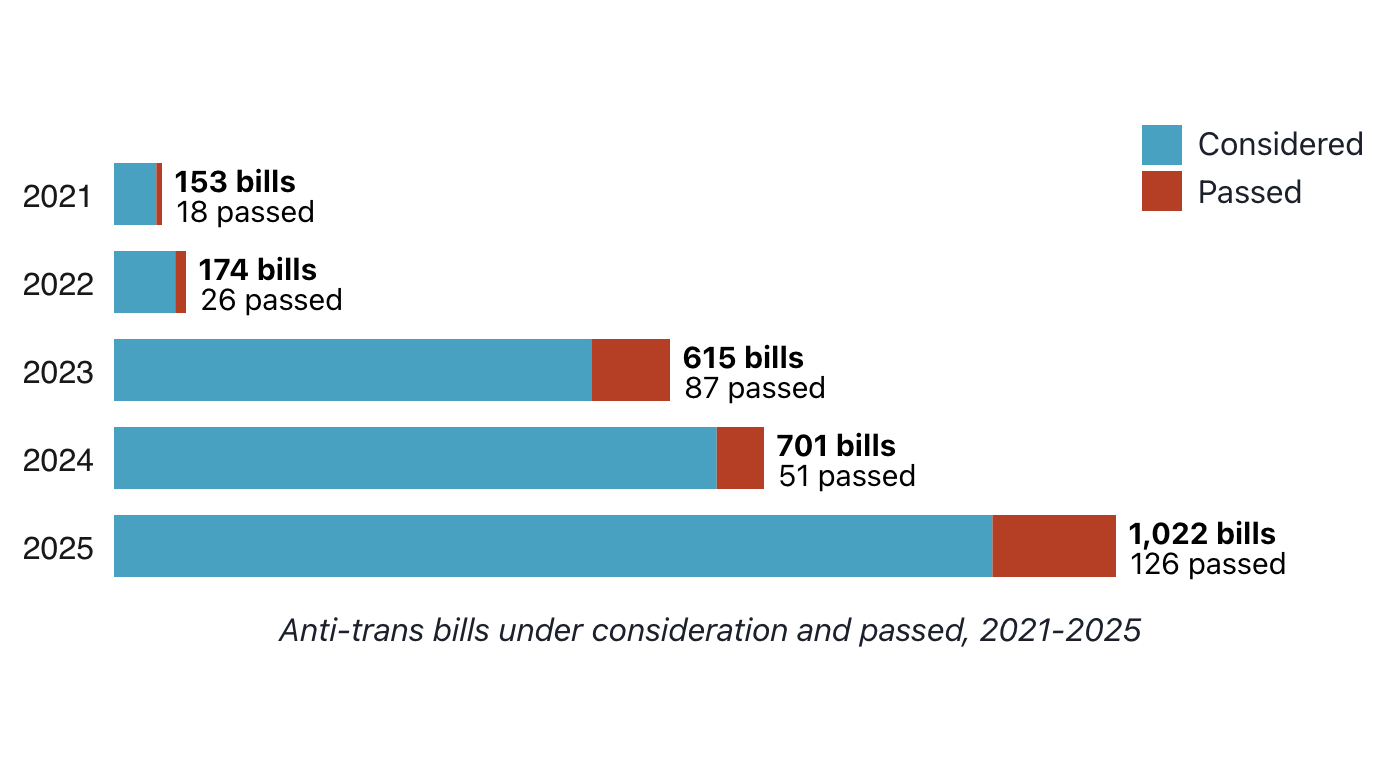
Another year, another cluster of hateful anti-transgender bills proposed in our state legislatures. This week, we round up some of the worst laws passed this spring in Southern states to further bully and harass trans people. In states like Tennessee and Georgia, this year’s bills are no longer only aiming at issues like sports and bathroom access, but are aiming directly at the presence — or even the mention — of trans people altogether.
In happier news, we also check in on this weekend’s Breaux Bridge Crawfish Festival in Louisiana. (Chart from TransLegislation.com)
The world’s richest man enjoys subservience from Southern lawmakers, while wreaking havoc on the earth, air and water.
Thermal drone imagery captured by Floodlight in late January shows some of the 15 permitted turbines operating at xAI’s Colossus 1. (Evan Simon / Floodlight)
Everyone is tired of hearing about Elon Musk. But he continues to have an outsized impact globally, nationally, and also specifically in several Southern states.
The theoretical richest man in the world is worth an estimated $840 billion or so at the moment, and in the near future he may become the world’s first trillionaire. That gives him a lot of power, obviously, and that power is compounded in the United States by his close ties to the current Republican Party.
One result is that in Republican-dominated states, including much of the South, the political leadership tends to be deferential to Musk, if not outright subservient to him. And he is taking advantage of that in several ways.
For example, let’s take a look at Austin, Texas, where Musk’s Tesla company opened a manufacturing plant in 2021. Gigafactory Texas, as the facility is known, was originally projected to employ 60,000 people — and in return, received a local tax break of up to 80 percent off its property tax bills. The incentive is worth about $14 million over 10 years.
But the factory has never come anywhere close to 60,000 employees, peaking at a bit over 20,000 employees before a slowdown in Tesla sales led to job cuts in 2024 that was one of the largest mass layoffs in Austin history, and even further cuts in 2025.
By the end of last year, there were about 16,500 employees at the plant. Meanwhile, the Texas Tribune reported last week that the plant continues to increase its water usage, surging to about 550 million gallons last year — making it the third-largest customer of Austin Water, the city-owned local utility.
This growing demand from Tesla has come as Central Texas is experiencing an ongoing drought, compounded by the growth of the Austin metro area in recent decades. Local residents are currently under water-use restrictions that limit them to watering their lawns or gardens no more than twice a week, and those rules could become more severe if the area moves from a Stage 3 to Stage 4 drought, as many experts predict.
Paul DiFiore, an environmental attorney who sits on an Austin water task force, told the Tribune, “It’s extremely alarming. All of a sudden, they’re using more water than the vast majority of people in the city.”
None of that has hampered Musk’s plans to add even more demand to the system. In March, he announced a forthcoming semiconductor fabrication plan near the existing factory, which will require even more water — potentially billions of gallons a year.
——-
Water is also an issue at another Musk project — the controversial XAI data center in Memphis, Tennessee. We’ve talked about this before, in the context of air pollution associated with gas turbines that Musk built — apparently illegally — to help power the massive computing facility, which is aptly named Colossus.
But Colossus also requires water — lots of it — to keep the supercomputer from overheating.
The original plans for the project that Musk and his team presented to state and local officials called for a huge water recycling plant, to allow it to reuse the same water over and over and minimize its impact on local resources.
But on April 9, local Memphis media reported that company officials said the water plant was paused in definitely, while work continues on building the second phase of the project, known as Colossus 2.
XAI and Musk said they weren’t canceling plans for water recycling, just delaying them while proceeding with “more immediate projects at the site.”
In at least the near term, though, that means the plant will be drawing billions of gallons a year directly from the same aquifer that serves the residents and other businesses of the Memphis metro area.
Memphis Mayor Paul Young, who has supported XAI despite the opposition of many local residents and environmental organizations, posted concerns about the delay, saying, “Promises to this community are not optional. A wastewater facility is about protecting our water and our future. I will continue pressing xAI to deliver.”
Despite all of that, in the last two months XAI has gone ahead and filed for local permits for its Colossus 2 expansion plans.
——-
Meanwhile, just two miles across the Mississippi state line from Memphis, another XAI data center is also facing complaints about air pollution and gas turbines.
The company’s new center under construction in Southaven, Mississippi, was heralded in a press release this past January by Governor Tate Reeves, who said it “sets the pace for continued high-tech investments across our state and strengthens Mississippi’s position as a leader in this exciting tech revolution.”
Of course, data centers are not in and of themselves great economic drivers. They can employ hundreds of people during construction, but once they’re up and running they have small staffs relative to their outsize impact on local utilities and the environment.
And those impacts are already showing up in Southaven. As at the center in Memphis, thermal imaging with drones has shown more than a dozen gas turbines operating from flatbed trailers at the site, all without state permits.
State regulators have said the turbines being on trailers makes them temporary, and therefore not in need of air pollution permits. But the Environmental Protection Agency has already ruled against that interpretation in Memphis.
In an investigation by the climate-focused journalism site Floodlight, former EPA air enforcement chief Bruce Buckheit said the Mississippi turbines are in clear violation of federal law.
XAI did not respond to the outlet’s request for comment.
The NAACP filed a lawsuit last week against xAI over the operation of the turbines.
——-
Air and water aren’t the only elements Musk is disturbing in his marauding across the South. In Nashville, local residents are worried about the ground, too.
Specifically, the limestone underlying what geologists call the Nashville Basin, and all of the buildings and infrastructure that sit on top of it.
Last year, Musk and state Republican officials announced with much hoopla something called the Music City Loop — an underground tunnel that is planned to run between downtown Nashville and the city’s airport about 13 miles to the east.
It is modeled on an existing loop built in Las Vegas by Musk and his Boring Company. Like that one, the Nashville loop will be for the use only of chartered Teslas, which will drive paying customers into town or out to the airport and bypass the often congested local interstates.
It was announced with almost no serious planning or analysis of the underlying terrain. The state granted the company permission to start digging from a state-owned site downtown, and work commenced almost immediately.
Nashville residents and city officials have raised questions and concerns ever since, about both the benefits of the loop — which they say will mostly serve tourists — and the potential complications of constructing such a long tunnel beneath densely populated areas and busy highways.
Among other things, they have cited more than 800 environmental violations allegedly committed by the Boring Company in its Las Vegas project. In March, the Nashville Metro Council approved a resolution opposing the project on a 20-15 vote.
But the locals have little authority over the project, which is mostly using state right-of-way. And last week, the Tennessee General Assembly voted to create a new state board just to oversee the Nashville loop project, with all members appointed by the state’s Republican leaders.
During discussion of the bill, Democratic State Representative Justin Jones of Nashville said, “We are bending state law to serve the whims of one man against the interests of Nashville.”
Nonviolent resistance was the core strategy of the Civil Rights Movement of the 1950s and ‘60s, and its chief architect alongside Rev. Martin Luther King Jr. was another pastor, Rev. James Lawson Jr. Like King, he studied the success of Gandhi’s anti-colonial resistance in India, and he answered King’s call to teach its precepts to thousands of young African-Americans in the South. Lawson died in 2024, but a new memoir — Nonviolent — gives vivid dimension to his life and his ideals. This week, we talk to the book’s co-author, writer and journalist Emily Yellin, who knew Lawson for most of her life and worked closely with him on the text. She says Lawson never stopped fighting for justice, over the years taking on causes including the rights of women, LGBTQ people, and Palestinians, among others.
Also: We look Elon Musk’s expanding corporate footprint across the South — a Tesla factory is draining Austin’s drought-depleted aquifer, xAI data centers in Mississippi and Memphis are threatening the local air and water, and his Boring Company is punching a hole in Nashville’s limestone despite the opposition of local residents.
Plus, a preview of this weekend’s MerleFest celebration of roots music in Wilkesboro, N.C.
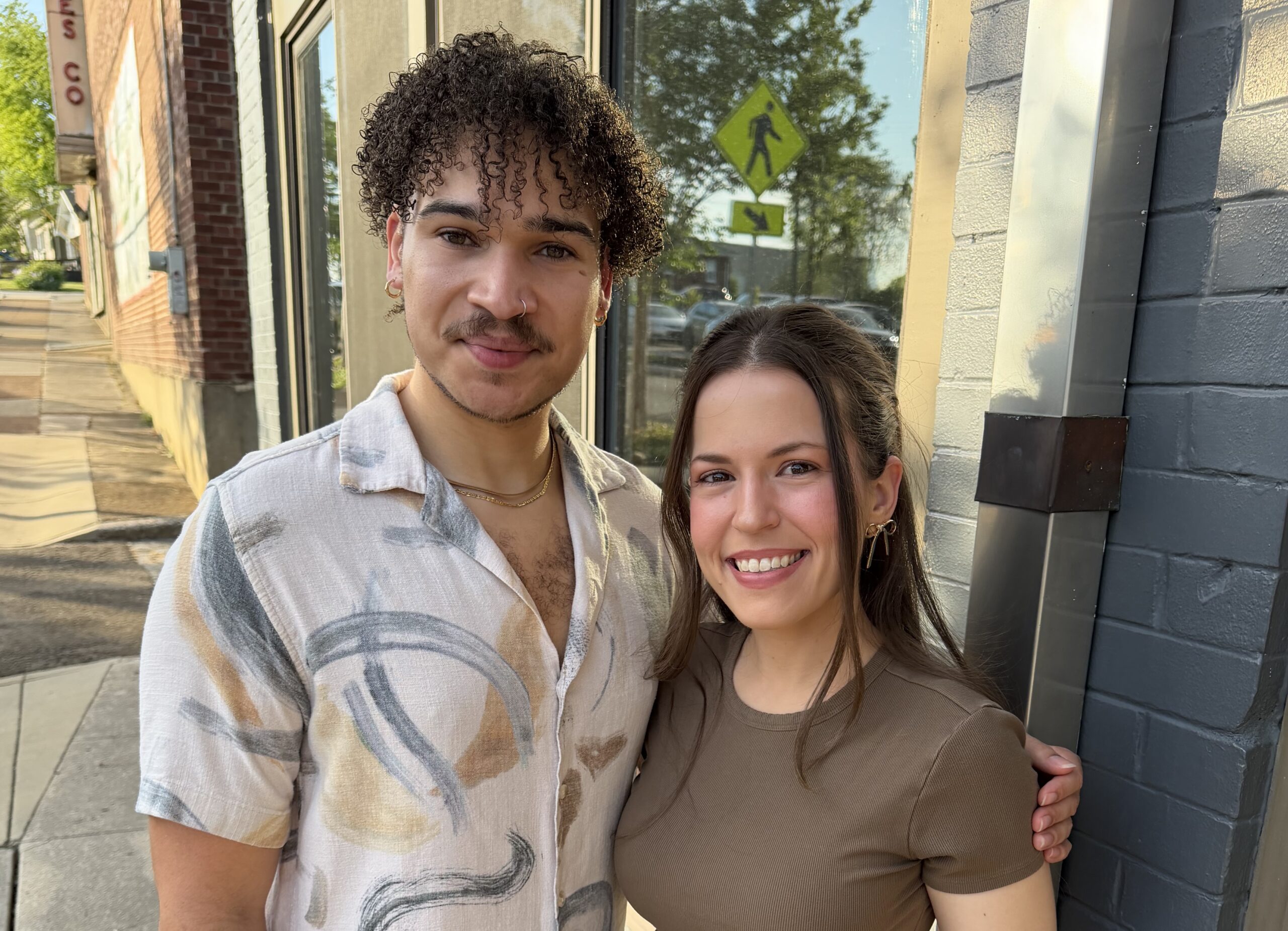
The Democratic Party has an identity problem with voters nationwide, and especially in the South. But a rising wave of young party activists is seeking to bring new energy and ideas into some of the most conservative areas of the country — like Knox County, Tennessee, which has been sending Republicans to Congress since the Civil War. This week, Jesse talks to Solomon Trapp and Julia Kaye, two organizers of a new Young Democrats chapter in the county. They say there is a hunger among younger Southerners for alternatives to prevailing political powers, which aren’t addressing their needs.
Also: Curriculum fights across the South. Texas reshapes its social studies standards to emphasize the state’s accomplishments and downplay less admirable parts of its history. Florida’s war on sociology. And in Virginia, some tensions about how to teach the events of January 6th.
Plus: A look at the Arkansas Folk Festival, marking its 64th year this weekend.
El Paso is a city at multiple borders — not only between countries, but cultures, languages, and histories. This week we talk to journalist Jazmine Ulloa, an El Paso native whose new book about her hometown dives into more a century of its history. Following the stories of five families, she traces the ways El Paso and the United States have been shaped by successive waves of migration and the never-ending fight over who belongs and who doesn’t.
Also: Dems flip two more seats, this time in Florida; Louisiana forces the 10 Commandments into every classroom in the state; and two anti-LGBTQ bills die (for now, anyway) in the Tennessee Legislature. Plus, a look at Little Rock’s unusual purse museum and what it says about women’s history.
NOTE: Due to an editing snafu, a few sentences were cut from the start of the discussion of laws mandating the posting of the 10 Commandments in public schools. Please see the Show Notes for the missing text.
Show Notes:
Here’s the missing text from the 10 Commandments discussion:
“Posting the 10 Commandments in public spaces has been a popular rallying point for Christian conservatives for decades. Former Alabama Supreme Court Chief Justice Roy Moore was famously ousted from office in 2003 for refusing to remove a large sculpture of the Old Testament edicts that he had had installed in the rotunda of the court building.
Federal judges ruled that Moore’s sculpture violated the constitutional separation of church and state.
But successive waves of conservative appointments to the federal bench and especially the U.S. Supreme Court have shifted the landscape for religious expression by public entities, with rulings in several cases broadening the legal scope of what’s allowed.”
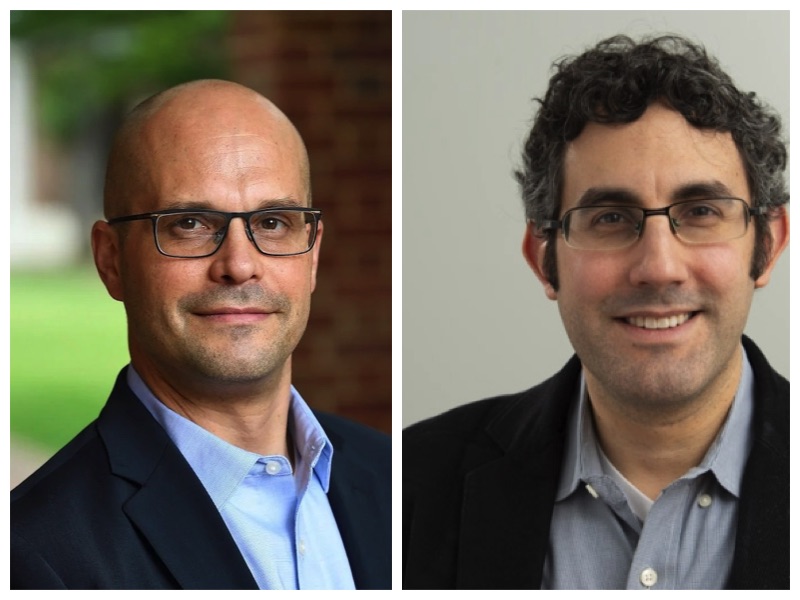
Everyone knows the air around Louisiana’s Cancer Alley is bad. But how bad? And what’s actually in it? That’s what two scientists at Johns Hopkins University set out to understand. Their work so far has shown the air in the communities around massive petrochemical plants has as much as 10 times higher levels of toxins than was previously known. This week, we talk to Peter DeCarlo and Keeve Nachman about their findings and the technology they used to do the research.
In the news: Florida sheriffs call for a different approach on immigration enforcement; several Southern legislators fan anti-Muslim bigotry; and a data dashboard illustrates the economic impacts of gun violence in Tennessee. Plus: the Big Ears Festival returns to Knoxville.
As minority whip for the Georgia state Senate Democrats, Senator Kim Jackson helped lead the fight in this session for a package of bills aimed at reining in aggressive immigration enforcement in the state. Republicans have blocked them, but this week Jesse talks to Jackson about the proposals and the public outcry that led to them. She also talked about her perspective and role as an Episcopal priest, a farmer, and a queer person of color in the Legislature.
Also: Overt racism and ethno-nationalism are surging on the right. We take a look at leaked chat messages from young conservatives in Miami, the popularity among young Florida voters of far-right gubernatorial candidate James Fishback, and the efforts by the Texas-based Center for Baptist Leadership to push the Southern Baptist Convention into full embrace of white Christian nationalism.
Plus: A preview of upcoming shows in Texas by Ballet Leplanta, which fuses classical ballet with Mexican folkloríco.
A raft of primaries and one special election in the South last week brought some fresh faces into the spotlight and offered tantalizing clues about this fall’s midterms. This week we take a look at the high-profile Democratic and Republican contests for U.S. Senate in Texas, as well as a slate of anti-establishment votes in both parties in North Carolina. Plus, an Arkansas state House district flips blue. (Photo: Two of last week’s winners — Texas state Rep. James Talarico and Charlotte, N.C., Pastor Rodney Sadler.)
In part 2 of our look at ICE incarceration in the South, we drop in on a packed meeting in heavily Republican Wilson County, Tennessee — where nobody, Democrats or Republicans, wanted a massive new detention center. It’s part of a bipartisan wave of resistance to the facilities across the country, which is complicating the federal government’s plans for massive warehousing of immigrants.
And we check in on an exhibit of the Kentucky photographer Ralph Eugene Meatyard’s work, at Atlanta’s High Museum.
“ICE was our first customer 43 years ago, and has been our largest customer for over a decade. From the end of 2024 through the end of 2025 ice populations in our care increased 5,903 individuals, to just over 16,000 or 58%.” — Patrick Swindle, President and COO of CoreCivic, in Feb. 12 quarterly earnings call.
CoreCivic is based in Brentwood, Tennessee. It was founded in Nashville in 1983 as the Corrections Corporation of America. It is one of the two largest private prison companies in the United States. The other is the GEO Group, based in Boca Raton, Florida.
It is not exactly a coincidence that for-profit prisons have taken root most readily in the South, with its long history of convict leasing and prison labor. In CoreCivic’s case, the connection is direct. One of its co-founders, Terrell Don Hutto, got his start in the late 1960s working at Ramsey Prison Farm, run by the state of Texas on land southwest of Houston that had formerly been home to slave plantations.
“Mostly black convicts were forced to pick cotton from dawn to dusk for no pay. It was 1967 and the Beatles’ ‘All you need is love’ was a hit, but the men in the fields sang songs with lyrics like ‘Old Master don’t you whip me, I’ll give you half a dollar.’ Hutto’s family lived on the plantation and even had a “house boy,” an unpaid convict who served them.”
Hutto went on to work in state prison systems in Arkansas and Virginia.
He started Corrections Corporation of America with partners Tom Beasley and Richard Crants. Beasley was a lawyer and former chair of the Tennessee Republican Party. Crants was a Nashville businessman who had worked in real estate and television, and had also been a roommate of Beasley’s at West Point.
CCA pioneered the private prison model, contracting with both federal and state governments to house and manage prison populations at a set daily rate per inmate. It grew quickly, and by 1998 it made Fortune’s list of the 100 fastest-growing companies in the United States.
Immigration detention has been part of its portfolio from the start. Its very first contract was with what was then called the Immigration and Naturalization Service, to operate a hastily remodeled hotel in Houston as a detention center.
The company has also for decades attracted controversy, criticism and lawsuits from prisoners and their families over allegations of abusive conditions. By the end of the second Obama administration, in 2016, public opposition to private prisons had grown to the point that the Department of Justice said it would phase out the federal use of them.
That same year, conscious of the toll of years of negative publicity, the Corrections Corporation of America rebranded itself as CoreCivic. Company officials said the name was intended to reflect a broader scope of services — but in reality, detention remains their primary business.
President Trump reversed the Obama Department of Justice order during his first term, which was a boom time for private prisons. But when President Biden took office in 2021, he issued an executive order to end federal private prison contracts — with a major exception. Although he had promised immigrant rights advocates that he would also end for-profit immigration detention, he did not.
In fact, when New Jersey passed a law in 2023 that would have shut down a CoreCivic immigration detention center in the state, the Biden administration supported CoreCivic in a successful lawsuit to keep it open.
Of course, the second Trump administration has been a whole new dawn for immigration detention. Investors understood it. CoreCivic’s stock price leapt 59 percent after Trump’s election in 2024, and Geo Group’s saw a nearly 100 percent rise.
By the end of 2025, the federal government was keeping more than 70,000 immigrants in detention facilities — the most ever, up from about 45,000 at the end of the Biden administration.
Which brings us to the February 12th earnings conference call, a standard quarterly event for publicly traded companies to report their financial performance and outlook for the future.
On the call were CoreCivic President and COO Patrick Swindle — who was promoted to that post in December 2024 — and Chief Financial Officer David Garfinkle.
They had good news to share. The company’s total revenue for 2025 was $2.2 billion, up 13 percent from the year before. And its earnings before interest, taxes, depreciation and amortization — a favored Wall Street metric known as EBITDA — was up 11 percent.
Even better from the company’s point of view, the year ended on a strong note. 4th quarter revenue was up 26 percent from the previous year, reflecting a surge in immigrant detentions as ICE hired thousands of new agents.
At the end of 2025, CoreCivic was holding nearly a quarter of all Immigration and Customs Enforcement detainees.
Swindle began the call with a report, which he introduced in the dispassionate language of corporate finance. If you didn’t know who he was talking about, it could be nearly any company traded on the stock exchange.
He then moved into discussion of CoreCivic’s actual business. But you’ll notice something here and throughout the call. What CoreCivic actually does — lock people up in cells and keep them there against their will — is never referred to except obliquely. The discussion is of “facilities” and “occupancy” and “beds” — but rarely of people.
Swindle reports on what he calls the “activation” of four prisons that had been closed, some because of the Biden administration’s move away from private prisons, at least for U.S. citizens, and others because they had lost state contracts. The Diamondback Correctional Facility in Watonga, Oklahoma, had been sitting empty since 2010. It was built to hold inmates from Arizona, until it ended its practice of sending prisoners out of state.
The California City center that Swindle mentioned deserves some particular notice. It is in the middle of California’s Mojave Desert, miles from any town. CoreCivic built it in 1998 and ran it as a federal prison until 2013. When that contract ended, the state of California leased the property and ran it as a state prison with its own staff until 2023.
Still owned by CoreCivic, it then sat empty until last year, when the company reopened it under contract with ICE. Since then, it has generated numerous reports of abuse and neglect.
In a New Yorker article in January 2026 with the headline, “The Cruel Conditions of ICE’s Mojave Desert Detention Center,” reporter Oren Peleg wrote that within months of reopening, the center became notorious for neglecting the medical care of its detainees.
After talking to many currently or formerly held there, he wrote, “These detainees reported adequate care at other ICE detention and processing facilities they were previously held at, and described the California City facility as unique in its mistreatment of those held in its custody.”
Peleg said detainees told him about “extremely delayed appointments with health-care professionals, the denial of medications and treatment, experiences with unsafe and unsanitary living conditions, and a general antagonism by medical staff toward detainees.”
According to the article, one detainee with a bleeding ulcer was refused a request to see a gastro-intestinal specialist and told that he should “go back to your own country” if he wanted medical care.
In November, the Prison Law Office, the ACLU, and other organizations filed a class-action lawsuit against ICE and the Department of Homeland Security over conditions at the center. In the filing, detainees refer to California City as a “torture chamber” and “hell on earth.”
Swindle obviously didn’t think any of that was worth mentioning to investors.
He did talk a bit more about the fourth reactivated vacant prison, which is in Leavenworth, Kansas. CoreCivic was ready to receive prisoners there, but there had been a hang-up.
So, about that. What Swindle is calling Midwest Regional here was formerly known as the Leavenworth Detention Center. It holds sort of a special place in the CoreCivic universe. In 1992, it was the first private prison opened under a federal agency contract, with the U.S. Marshals Service.
The prison expanded over the decades, from holding 460 people to a little over 11 hundred. It also accumulated a growing number of complaints about safety and living conditions.
In 2021, the ACLU sent a letter to the Biden administration detailing reports of violence involving both prisoners and guards. It urged the administration not to renew CoreCivic’s contract — and it didn’t.
When the contract expired at the end of that year, remaining prisoners were transferred and the prison was closed. Last year, CoreCivic contracted with ICE to return it to service as an immigrant detention center.
But there was local pushback, and a lawsuit forced CoreCivic to apply to the city for a new special use permit. That’s the discussion Swindle referred to, which is still unresolved.
Swindle then moved on to broader discussion of what he called “the business climate.” Which is to say, the climate of the business of locking up immigrants.
Looking forward, Swindle said he sees ongoing opportunities. CoreCivic still has more vacant prisons just waiting to be reopened. There are also some open beds at already operating prisons. Swindle assured his shareholders that the company is ready if and when ICE calls.
This next short clip is interesting mostly because it’s one of the few times where Swindle acknowledges the people his company imprisons as something more than part of a so-called market demand. The word “humane” stands out here — but then also listen to all of the other things that come after it.
The best value to the government. The best value to taxpayers. It’s a good reminder of who is actually paying for all of this — whose money CoreCivic is using to bolster its bottom line and pay its executive salaries and lobby for more public contracts.
It’s our money. It is even the money of the very people they are incarcerating. One study found that undocumented immigrants paid an estimated $97 billion in combined federal, state and local taxes in 2022. Are they getting the “best value” from their tax dollars going to pay CoreCivic? Are we?
In making a point about how quickly the company moved to take advantage of ICE opportunities in 2025, Swindle talked about yet another facility: the Dilley Immigration Processing Center in Dilley, Texas. It is a family detention center, where parents can stay together with children.
As Swindle noted in the call — and as a reminder that mass immigrant detention has been a bipartisan policy — it was originally commissioned and opened in 2014 under the Obama administration. Swindle described it with pride.
I did go and take the virtual guided tour. It shows playgrounds, classrooms, a medical clinic, a room where children can play video games. The sleeping quarters are rows of bunkbeds where, it says, families are kept together. Right next to other complete strangers, of course.
But there’s a funny thing about the photos in the tour — there are no people in them. They show pristine, empty rooms. This is partly for legal privacy reasons, I suppose. But the absence feels deliberate.
As if CoreCivic knows that the illusion it is trying to present of a professional, friendly place — like a children’s hospital, maybe — would be harder to sustain if you could see the people, and especially the children, being held prisoner there.
Swindle mentioning the Dilley center at all took me aback. Because Dilley had been very prominent in the news in the days before the earnings call.
It was where 5-year-old Liam Ramos — the boy in the blue bunny hat — was taken with his father when they were arrested by federal agents in Minneapolis. Photos of Liam being detained made international news and fueled public outrage. He and his father were released on February 1st after a federal judge ruled that agents hadn’t followed correct procedures in detaining them.
Then, on February 9th, the nonprofit media site ProPublica published a report about other children at Dilley. It included drawings and letters recounting their fears and sadness at being held at the center.
A 14-year-old girl from Colombia wrote, “The workers treat the residents unhumanly, verbally and I don’t want to imging how they would act if they where unsupervised.”
Another Colombian girl, who is 9 years old, drew a picture of her and her mother wearing their detainee ID badges. She wrote, “I am not happy, please get me out of here.”
Swindle, of course, did not mention any of this to his shareholders.
What he did talk about was the money that came from all of it.
Swindle wrapped up his presentation with a bit of corporate rah-rah that could have come from any company, again using words like “core portfolio” to refer to large prison complexes holding thousands of people.
He then passed off to CFO David Garfinkle, who provided the meat of what investors probably really wanted to hear about — revenues, profits, and growth projections. This particular clip caught my ear not for the blizzard of financial jargon but for one word that he used to describe CoreCivic’s services.
“Solutions.” If you ran a company that specialized in mass detention of people in prison facilities that meet the literal dictionary definition of concentration camps, maybe you’d be careful about referring to what you offer as “solutions.” Or maybe not.
The call next moved into questions from investors, which like the rest of the discussion felt weirdly disconnected from the actual business at hand. There were queries about capacity, liquidity, stock buybacks. But a couple of callers showed at least some awareness of headlines outside the business pages.
One question came from Greg Gibas, a senior research analyst at Northland Securities — an investment firm based in, of all places, Minneapolis. And Gibas did have questions about the goings-on in the city — but mostly a concern that comments by Trump administration Border Czar Tom Homan might represent a reduction in ICE detentions, and therefore fewer bodies in CoreCivic’s care.
Swindle was swift to reassure him that Minneapolis was an unusual operation because of its size, and reducing its scope shouldn’t mean fewer detainees nationwide — or what he refers to as “pipeline opportunity.”
Then there was the call from Joe Gomes of Noble Capital. The audio on Gomes’ line is a little weak, but I wanted to play this exchange because of the upbeat tone and tenor of Gomes’ questions as he asked Swindle to estimate how much financial “upside” there could be if CoreCivic actually fills all of its currently vacant facilities and beds.
He also expressed concern that ICE has been a little slower than expected in ramping up the volume of its detentions, and asked for reassurance that the pace will pick up. Swindle explained that ICE is a “complex ecosystem.”
This runs a couple of minutes as there’s back and forth between the two of them.
Listening to the call, with its blasé boosterism and revenue growth projections, it was hard for me not to think of Hannah Arendt’s endlessly quoted observation about Adolf Eichmann representing what she called “the banality of evil.”
The phrase is especially tempting because Eichmann played an instrumental role in organizing the mass deportation of Jews to concentration and extermination camps.
But it also seems in some ways insufficient. At his war crimes trial in 1961, Eichmann’s defense was that he was just following orders within a rigid bureaucracy. (This was of course not persuasive, and he was hanged for his crimes.)
CoreCivic and its investors aren’t following orders. They’re enthusiastically seeking contracts. Nobody is making them do it.
They’re pursuing year-over-year quarterly gains. They’re chasing EBIDTA. They’re speculating about blue skies and upsides to their business model. They’re promising stable occupancy by mid-26.
CoreCivic does not run death camps, it’s true — although people do die in their custody. It runs the Trousdale Turner Correctional Center in Hartsville, Tennessee, for example — a state prison where 98 prisoners died between 2019 and 2022.
The number was high enough that even Tennessee’s Republican Legislature passed a bill that will reduce Trousdale’s population — and therefore its revenues — by 10 percent any time the death rate is more than twice the average at the state’s publicly owned prisons.
But even if the deaths in CoreCivic’s detention centers are more a side effect than a mandate, there’s no escaping the brutal calculus at the heart of the business. CoreCivic does best when the government is rounding up more people and needs someone to keep them locked up.
Liam Ramos, the boy in the bunny hat, was kept prisoner by CoreCivic for 10 days. CoreCivic is paid about $165 a day for each detainee.
U.S. District Judge Fred Biery, who ordered the release of Liam and his father, had harsh words for ICE and the Trump administration’s approach to mass deportation. In his order, he wrote, “The case has its genesis in the ill-conceived and incompetently-implemented government pursuit of daily deportation quotas, apparently even if it requires traumatizing children.”
He added, “Observing human behavior confirms that for some among us, the perfidious lust for unbridled power and the imposition of cruelty in its quest know no bounds and are bereft of human decency. And the rule of law be damned.”
His order made clear that neither Liam nor his father should have been arrested in the first place, much less shipped from Minnesota to a detention center in West Texas. But they were still worth about $1,650 apiece to CoreCivic.
That money, and money from tens of thousands of other people torn from their families and communities, will show up in the company’s next quarterly earnings.
As the Trump administration’s aggressive mass deportation campaign has ramped up, so have the profits of private prison companies. This week, we take a look at CoreCivic, the Tennessee-based company that is one of the two largest operators of private prisons in the United States. It has been in the immigrant detention business for more than 40 years, and last year was one of its best ever thanks to its close relationship with U.S. Immigration and Customs Enforcement.
We listen in on CoreCivic’s most recent quarterly earnings call, full of rising revenue numbers and rosy projections — and we annotate it with context and background that the executives somehow failed to mention to their investors. We also take a look at the company’s history, and its direct connections to the South’s ugly legacy of for-profit prisons.
Plus: a preview of an upcoming tribute to Mississippi folk artist L.V. Hull.
On back to back days earlier this month, the Tennessee Valley Authority reversed course on plans to close two massive coal-fired power plants, and the Trump administration abandoned federal regulation of greenhouse gases. The double whammy clearly illustrated the impact of the administration’s aggressive insistence on fossil fuels, regardless of the local and global cost. To get a handle on the implications, this week we visit again with Steve Smith of the Southern Alliance for Clean Energy. He accuses the administration of an Orwellian denial of the reality of climate change.
Also: Attacks on tenure in Tennessee, a move to restore voting rights to people convicted of felonies in Kentucky, and a remembrance of the Reverend Jesse Jackson’s South Carolina roots. Plus: a historical exhibit of Black Southern crafts at the International African American Museum in Charleston, S.C.
When it comes to environmental protections, the Trump administration has been on a deregulatory spree. On the front lines of fights to protect air, water and ecosystems across the South is the Southern Environmental Law Center — a nonprofit with a team of more than 100 lawyers, who are keeping busy in courts and on Capitol Hill. This week we talk to Geoff Gisler, Program Director for the SELC, about the biggest threats to Southern communities and landscapes the group saw in the first year of Trump 2.0, and what they foresee coming.
Also: the election conspiracy theorists behind the FBI’s seizure of Georgia ballots from 2020; allegations of censorship at the Medgar and Myrlie Evers Home National Monument in Mississippi; and Florida takes another step toward blocking any regulation of greenhouse gases.
And: Alabama native Ella Langley takes the charts by storm with “Choosin’ Texas.”